
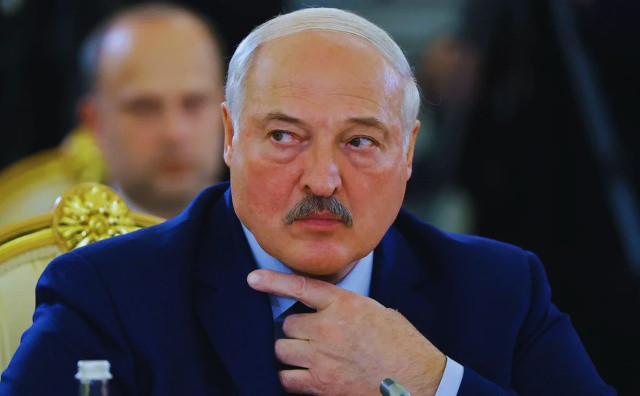
Belarusian President Alexander Lukashenko said this week he was willing to meet Volodymyr Zelensky anywhere, in Ukraine or in Belarus, to talk through what he called “the problems of Belarusian-Ukrainian relations.” Kyiv rejected the offer within hours.
“Since 2022, it has been obvious to everyone that this man’s words mean nothing, and we should pay attention to his actions,” Zelensky’s advisor Dmytro Lytvyn told reporters.
However, the timing was not incidental. Ukraine’s military intelligence had been tracking what Kyiv described as Russian preparations for a new offensive through Belarusian territory targeting the capital and the Chernihiv region. Zelensky said on May 21 that his government had analyzed data from its intelligence agencies on “Russia’s planning of offensive operations in the Chernihiv-Kyiv direction” and was preparing responses. He also instructed the Foreign Ministry to draft additional diplomatic measures against Belarus should Russia use its territory to expand the war.
This is not the first time Belarus has denied involvement while events moved in a different direction. In early 2022, Lukashenko also said his country would stay out of the conflict. Moscow then used Belarusian territory to cross into northern Ukraine and push toward Kyiv. The offensive failed. Russian forces withdrew after several weeks, though missile and drone strikes from Belarusian territory continued.
Lukashenko’s formula this time is familiar. “We are not going to get drawn into the war in Ukraine. There is no necessity for this. Neither civil nor military,” he said, adding that the only scenario in which Belarus could be pulled in was if “aggression is committed against its territory.” In 2022, he used an identical argument by claiming an attack on Belarus was being prepared, in order to justify lending Russian forces Belarusian soil and military facilities.
Zelensky, visiting Slavutych, a city roughly 50 kilometers from the Belarusian border, warned that the Belarusian leadership should “clearly understand that there will be consequences if aggressive actions against Ukraine, against our people, are taken.” He said Kyiv was also reviewing options for what he called “preventive” measures.
The backdrop to all of this was a joint Russia-Belarus nuclear exercise held between Tuesday and Thursday. Lukashenko participated in drills simulating the use of both tactical and strategic nuclear weapons, covering an area from Eastern Europe to the Pacific and involving hundreds of missile launchers, warplanes, warships, and nuclear submarines.
“We threaten absolutely no one,” Lukashenko said during the drills. “But we have such weapons, and we’re ready in every possible way to defend our common fatherland.”
As part of the exercise, Moscow transferred nuclear munitions to field storage facilities in Belarus. Russia also supplied Minsk with modified Su-25 fighter jets and Iskander-M ballistic missiles with a range of up to 500 kilometers. Nuclear warheads are reportedly stored at the Asipovichi military range, less than 200 kilometers from the Ukrainian border.
The deployment of Russian tactical nuclear weapons to Belarus began in June 2023, when Putin announced the move, framing it as a mirror of longstanding NATO nuclear-sharing arrangements in Europe. Tactical nuclear arms fall outside existing US-Russia arms control treaties, making them harder to monitor.
NATO Secretary-General Mark Rutte, attending a summit of alliance foreign ministers in Helsingborg, Sweden, said on Wednesday that any Russian use of nuclear weapons against Ukraine would draw a “devastating” response. The summit’s venue carried its own symbolism: Sweden joined NATO after Russia’s 2022 invasion, and the timing of the Belarus-Russia drills against the backdrop of the meeting was widely noted.
Russia’s Foreign Intelligence Service added its own message to the week’s events, claiming without evidence that Ukraine was planning to launch drones against Russia from Latvian territory, and warning that NATO membership would not protect “those who aid terrorists from just retribution.” Both Latvia and Ukraine denied the claims. European Commission President Ursula von der Leyen called the threats unacceptable. “Russia and Belarus bear direct responsibility for drones endangering the lives and security of people on our Eastern flank. Europe will respond with unity and strength,” she said.
Some analysts read the entire episode differently. Igar Tyskevych, a Belarus-born political analyst based in Kyiv, described the nuclear drills and accompanying rhetoric as “sabre-rattling. And not even with sabres but with threats.” In his reading, Zelensky deliberately raised the alarm to open a separate negotiating track with Minsk, and Lukashenko’s offer to meet was the signal back that he was open to it.
Lukashenko has reasons beyond military posture to want that conversation. Belarus is a country of 10 million people with a heavily state-controlled, export-dependent economy. Ukraine cut off Belarusian imports entirely after 2022. The European Union reduced its purchases by more than two-thirds through sanctions. In recent months, Lukashenko has sought to ease that pressure by warming ties with Washington and aligning with Trump’s peace framework, which in turn led the administration to relax some sanctions and push Ukraine, Poland, and Lithuania to allow Belarusian fertilizer shipments through.
Ukraine is unlikely to restore full relations with Minsk while Lukashenko remains in power. But analyst Tyshkevych suggested a partial reopening of trade was possible after a ceasefire. “Without separate talks with Minsk, Ukraine may have to heed to Washington’s recommendations to work with Lukashenko,” he said.
Whether that diplomatic opening survives depends partly on whether Lukashenko can resist pressure from Moscow to do more than host Russian weapons. Volodymyr Fesenko of the Kyiv-based Penta think tank said the current concentration of Russian forces in Belarus was “insufficient” for a serious offensive, and that drawing Belarus directly into the fighting would be “too big a risk” for Lukashenko personally. But he stopped short of ruling it out. “Unfortunately, there is such a risk,” he said. “But I think, however, that Lukashenko is afraid of getting involved in the war. He’ll escape such a development.”