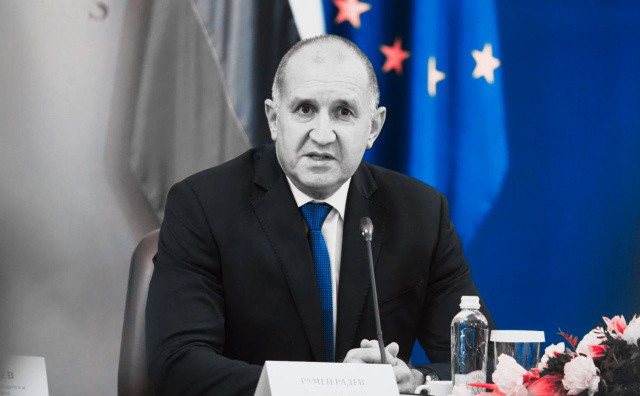
On Wednesday, at the start of a Council of Ministers meeting, Prime Minister Rumen Radev announced that Bulgaria would stop providing weapons to Ukraine. “We have already given enough,” he said. “Our country continues to suffer socio-economic damage from this bloody war.” The line was clean, declarative, and aimed at the cameras. It was also, on closer inspection, not really true.
Later, Defense Minister Dimitar Stoyanov began walking it back. Speaking to bTV, he made an important clarification. “We are stopping the provision of weapons and ammunition from the warehouses of the Bulgarian army. The word is provision, not sale,” he said. If Ukraine wants to buy weapons through Bulgarian defense industry channels, that remains entirely possible. Foreign Minister Velislava Petrova reminded journalists that any decision on aid, military or humanitarian, has to go through the Council of Ministers and then parliament, and that nothing has actually been formally decided yet.
What Was Actually Being Stopped
The first thing worth understanding is the scale of what Bulgaria was supposedly halting. According to opposition MP Ivaylo Mirchev of Democratic Bulgaria, roughly 98 percent of Bulgarian military aid that has reached Ukraine has come not from army warehouses but from the country’s defense industry, paid for either directly by Ukraine or through European partners. The European Peace Mechanism alone has channeled some 6.5 billion euros into the Bulgarian economy in exchange for that production. Former Economy Minister Bogdan Bogdanov, now a PP MP, estimates the broader Bulgarian defense sector employs around 70,000 people and is deeply integrated into international supply chains.
In other words, what Stoyanov announced he was stopping, the free transfer from army stocks, was the smaller and politically softer part. The real flow of Bulgarian weapons to Ukraine, the one that actually matters in volume, is commercial. As earlier reporting from UN Register of Conventional Arms documents has shown, Bulgaria has been one of Ukraine’s most significant arms suppliers since 2022, with most transfers routed through Czechia, Poland, Romania and the UK. That pipeline has continued under successive governments, including ones explicitly skeptical of military aid.
The Political Theater
Radev came to power on a platform that included clear skepticism of Western military support for Ukraine. He has called the Ukrainian cause “doomed,” argued repeatedly that the war cannot be won on the battlefield, and pushed for the EU to lead peace negotiations with Russia. His base wants to see those positions translated into action.
Stoyanov’s initial announcement, the version that traveled around the world via Bloomberg and POLITICO before being walked back, served exactly that audience. The headline was: Bulgaria stops arming Ukraine. The follow-up, that Bulgaria will still sell to Ukraine and to intermediaries who supply Ukraine, was made in a smaller, more technical setting and received far less attention.
GERB MP Georg Georgiev framed the dynamic bluntly. “One thing is said abroad in front of partners, and another thing is said for domestic political use, populist,” he told reporters. PP’s Nikolai Denkov, who served as prime minister in 2023 and 2024, raised a parallel concern, saying he would file a formal parliamentary question to Radev because the ministerial messaging looked either incoherent or deliberately contradictory. “If this is some kind of strategy to please everyone, it doesn’t work,” Denkov wrote. “If the ministers in the government don’t talk to each other, it’s even worse.“
The Money That Cannot Be Stopped
The reason none of this can be cleanly resolved is that stopping Bulgarian arms exports related to Ukraine would actually hurt Bulgaria. According to PP MP Radoslav Ribarski, the country has earned hundreds of millions of euros from defense exports over the past two years, money that has gone into modernizing the Bulgarian army itself, including the upcoming purchase of three-coordinate radars financed in part by Danish transfers. Bogdanov made the same point: “If the Bulgarian military-industrial complex is currently under pressure, isolated from international markets, this will directly affect the future of nearly 70 thousand people who work there.“
GERB’s position is broadly the same. The party’s official statement called the decision “a decision for Bulgaria’s place in Europe over the next twenty years,” and warned that supporting Ukraine and modernizing the Bulgarian army “are not opposing goals.“
The only party in parliament that wants a genuine halt is “Revival”. Party leader Kostadin Kostadinov said on Tuesday that his party would submit two proposals: a direct ban on weapons sales to Ukraine, and a ban on re-export clauses that would prevent third countries from passing Bulgarian weapons on to Kyiv. Kostadinov accurately identified the loophole Stoyanov’s “we will sell” position leaves open. “It is extremely hypocritical,” he said, “to claim that the war will not be resolved on the battlefield and negotiations are needed, while at the same time allowing the sale of arms.“
What This Actually Was
Strip away the rhetoric and what happened this week looks like a carefully calibrated piece of political messaging. Radev gave his pro-Russian and war-skeptic voters the headline they wanted. Stoyanov delivered the version of the announcement designed for international consumption, with the loopholes carefully preserved. Petrova reassured EU partners that nothing has formally changed. The defense industry keeps producing and selling, the army keeps receiving modernization funds, and the prime minister gets to say he stopped arming Ukraine.