
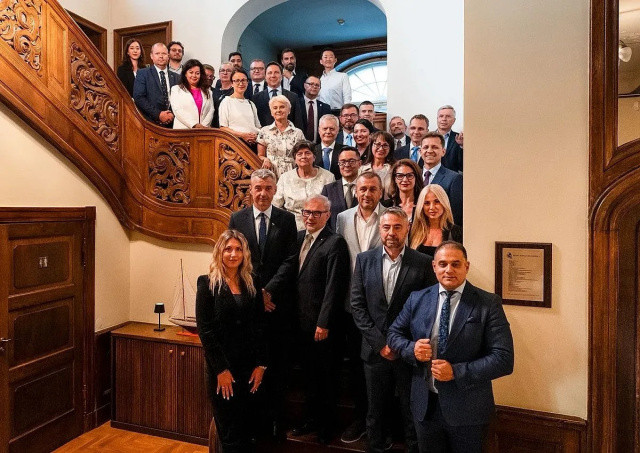
Bulgaria is seeking to deepen economic ties with Poland and attract more Polish investment, with Deputy Prime Minister and Minister of Economy, Investments and Industry Alexander Pulev stating that Sofia aims to develop its economy along the lines of the Polish model.
Speaking in Gdansk during a meeting with the Gdansk Business Club, held alongside the International Conference on the Recovery of Ukraine, Pulev emphasized that investment is now a national priority for Bulgaria and that Poland is considered a key strategic partner.
He pointed to Bulgaria’s geographic position as a major advantage, highlighting its role as a link between Europe, Asia, and Africa, as well as the transport, energy, and digital corridors running through the country. He added that Bulgaria is already building a stronger framework for industrial cooperation with Poland, describing the relationship as one with significant untapped potential.
Trade between the two countries has already reached 3.2 billion euros, while Polish investments in Bulgaria exceed 650 million euros, according to figures cited during the meeting. Pulev also praised Poland’s economic development, referring to its achievement of a 1 trillion US dollar GDP and long-term growth during its transition period.
“Bulgaria has the ambition to follow the model of the Polish economy,” Pulev said, adding that the country is working to reshape its economic profile and strengthen industrial cooperation. He noted that Bulgaria is emerging from a prolonged period of political instability and now has what he described as a stable governing majority capable of implementing reforms.
The Deputy Prime Minister outlined a series of upcoming policy initiatives aimed at improving the investment climate, including a new public-private partnership law intended to provide greater certainty for investors. He also pointed to planned modernization efforts in the energy sector, including investments in new nuclear capacity and supporting infrastructure to ensure stable supply for businesses and consumers.
Additional priorities include large-scale infrastructure development in transport, ports, and airports, with many of these projects expected to be implemented through public-private partnerships.
Pulev also stressed Bulgaria’s growing role in emerging technologies, noting that the country has been selected as one of six EU pilot states for investment in artificial intelligence infrastructure. He said Bulgaria is increasingly positioned within Europe’s technological transformation, including areas such as supercomputers and data centers.
In the defense sector, Pulev described the industry as a key element of national and European security. He stated that Bulgaria is aligning its production with NATO standards and exploring opportunities in new technologies, including drone manufacturing. He encouraged businesses to engage with Bulgarian innovative companies active in this field.
According to Pulev, Bulgaria and Poland share historical and cultural links, including Slavic heritage and linguistic similarities, which he said provide a strong foundation for expanding economic cooperation in the coming years.
The delegation in Gdansk included Bulgaria’s Ambassador to Poland Margarita Ganeva, Transport and Communications Minister Georgi Peev, Deputy Economy Minister Mihaela Karadimova, Deputy Transport Minister Hristina Velinova, Deputy Energy Minister Kiril Temelkov, BEH Executive Director Andrey Zhivkov, as well as representatives of the Bulgarian Embassy in Warsaw and STIV Poland.