
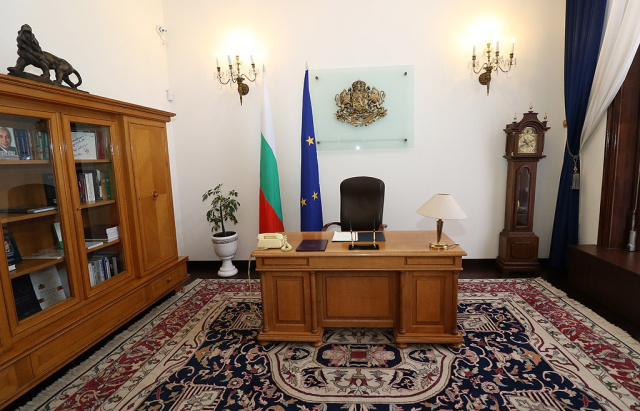
On Sunday, Bulgarians will choose a head of state for a five-year term beginning in January 2027 and most of them will do it knowing that the person they elect will not run the country. Bulgaria is a parliamentary republic. The prime minister and the Council of Ministers set policy, parliament passes the laws, and the president has no right to propose legislation, no seat in the cabinet and no say over the budget beyond a veto that 121 of the 240 MPs can override.
That makes the office sound weaker than it is. The president is the one official every adult Bulgarian votes for directly, commands the armed forces, represents the country abroad, decides when an election is called and, at moments of political deadlock, picks the people who run the state while parliament cannot. Over the past five years of snap elections those moments became routine, and the presidency grew into one of the most consequential institutions in the country, which is exactly why parliament moved in 2023 to cut it back.
From the Tsars to Dondukov 2
Bulgaria had no president for most of its modern history. From 1879 the head of state was a prince (knyaz), and from 1908 a tsar, until a referendum on September 8, 1946, abolished the monarchy and opened the way for the People’s Republic. Under communism the role passed to a collective body, first the Presidium of the National Assembly and from 1971 the State Council, which Todor Zhivkov chaired until his removal in November 1989.
The modern presidency was born in the turbulence that followed. In April 1990 parliament made Petar Mladenov, Zhivkov’s successor at the head of the State Council, the country’s first president. He lasted three months, resigning in July after a recording surfaced in which he was heard telling colleagues during a December 1989 protest that it would be better if “the tanks came.” The Grand National Assembly then elected dissident philosopher Zhelyu Zhelev in August 1990, and the constitution it adopted on July 12, 1991, turned the presidency into a directly elected office. Zhelev won the first popular vote in January 1992.
Since then the office has been held by Petar Stoyanov (1997–2002), Georgi Parvanov (2002–2012, the only president so far to serve two full terms), Rosen Plevneliev (2012–2017) and Rumen Radev (2017–2026). When Radev resigned in January 2026 to found Progressive Bulgaria and run for parliament, Vice President Iliana Yotova became the first woman and the first vice president to take over the office, serving out the remainder of his term. The presidency sits at 2 Dondukov Boulevard in central Sofia, which is why Bulgarians use the address as shorthand for the institution.
Who Can Run and for How Long
The constitution sets four conditions. A candidate must be a Bulgarian citizen by birth, be at least 40 years old, meet the requirements for election to parliament and have lived in Bulgaria for the previous five years. The term is five years, and a president can be elected only twice, consecutively or not. Once in office, the president cannot sit in parliament, hold any other state, public or business post or serve in a party’s leadership.
President and vice president are elected together on a single ticket. To win in the first round a ticket needs more than half the valid votes with turnout above 50 percent. If either condition is missed, the top two tickets go to a runoff a week later, where the higher vote wins regardless of turnout. No Bulgarian president has ever been elected in the first round, and with turnout this year expected below 40 percent, the November 1 runoff is all but certain.
The vice president has no independent powers of their own. The office exercises whatever authority the president delegates by decree, in practice the handling of pardons, citizenship and asylum, and steps in if the presidency falls vacant, completing the term. If both offices are empty at once, the Speaker of parliament acts as head of state until a new election, which must be held within two months.
The Veto, the Court and the Mandates
The president’s main tool against parliament is the right to return a law for reconsideration before signing it. The veto can be used only once per law, and the National Assembly overrides it by passing the text again with the votes of more than half of all MPs, 121 of 240, after which the president must promulgate it. Against a government with a stable majority, such as Progressive Bulgaria’s 131 seats today, a veto delays a law and forces a public debate, but it rarely stops one.
The stronger instrument is the Constitutional Court. The president is one of the few institutions that can ask the court to strike down a law or to give a binding interpretation of the constitution, and also appoints four of its twelve judges. The president can also formally propose constitutional amendments, although parliament decides on them.
Most presidential decisions take the form of decrees, and most decrees must be countersigned by the prime minister or the relevant minister, which keeps the government in the loop on appointments, awards and similar acts. The exceptions are the ones that matter politically: scheduling elections, dissolving parliament, returning laws, handing out mandates to form a government and appointing a caretaker cabinet all happen on the president’s signature alone.
Those mandates are where the office becomes central in a fragmented parliament. After an election the president hands the first mandate to form a cabinet to the largest parliamentary group and, if that fails, the second to the next largest. The third mandate goes to any group of the president’s choosing, a real discretion that has decided governments in the past. If all three fail, the president dissolves parliament, schedules a snap election and appoints a caretaker government to run the country until a new parliament elects a cabinet. Bulgaria has had a dozen caretaker governments since 1990, seven of them in the last five years.
Commander-in-Chief and the Face of the State Abroad
The president is supreme commander-in-chief of the armed forces and chairs the Consultative Council for National Security, which brings together the government, parliamentary leaders, the military and the security services. The council has no executive power, but convening it is a political signal. The president appoints and dismisses the senior military command and confers the highest ranks, though only on the government’s proposal, and the constitution allows the head of state to declare war or martial law when parliament is not sitting, subject to its later approval.
Abroad, the president represents Bulgaria, receives the credentials of foreign ambassadors and, on the government’s proposal, appoints and recalls Bulgaria’s own heads of mission. Foreign policy itself belongs to the cabinet, and the president usually does not represent the country at European Council summits, where the prime minister sits.
The president also signs the decrees that appoint several of the state’s most powerful officials once other bodies have chosen them, including the prosecutor general and the heads of the two supreme courts. The president may send a nomination back once, but a repeated proposal must be signed.
Pardons, Citizenship and the Quieter Powers
Some of the presidency’s most sensitive work happens far from the headlines. The president grants, restores and revokes Bulgarian citizenship, grants asylum, pardons convicted criminals and can write off uncollectable debts to the state. By long tradition these powers are delegated by decree to the vice president. A presidential commission reviews the requests, but its members have been kept anonymous, and the motives behind individual pardons are not routinely published, which is why critics are now calling for the process to be opened up.
The president also awards state orders and decorations, renames towns and villages, schedules local elections and national referendums once parliament has approved them and addresses the nation on New Year’s Eve.
Immunity and Impeachment
While in office, the president and vice president cannot be detained or criminally prosecuted, and they bear no liability for acts performed in the course of their duties, with two exceptions. They can be removed for high treason or for violating the constitution. An impeachment motion needs the signatures of at least a quarter of MPs and must then be approved by more than two-thirds of the National Assembly, 161 votes, before the case goes to the Constitutional Court, which has one month to rule. If the court finds the president guilty, the mandate ends.
The bar is high enough that it has never been cleared. The nationalist Ataka party tried to start proceedings against Rosen Plevneliev in 2013 after he backed early elections during that year’s protests, but it could not even gather the support to put the motion on the agenda. A president can otherwise leave office early only through death, a permanent illness that prevents the work, or resignation, which must be submitted before the Constitutional Court.
How the Office Grew, and How Parliament Cut It Back
For most of the post-communist era the caretaker power was a formality, used briefly between elections. That changed after 2021, when Bulgaria entered a cycle of eight parliamentary elections in five years. Each failed parliament left Radev to appoint another caretaker cabinet, and the governments of Stefan Yanev and Galab Donev, both men ran the country for long stretches, signing off on energy contracts, defense decisions and the handling of the war in Ukraine without any parliamentary majority behind them. Critics argued that the president had effectively become the head of the executive.
Parliament answered on December 20, 2023, when GERB, We Continue the Change, Democratic Bulgaria and the Movement for Rights and Freedoms passed the sixth amendment to the 1991 constitution. Alongside a large judicial reform, it took away the president’s free choice of caretaker prime minister. The president must now pick from a short list of officials: the Speaker of parliament, the governor or a deputy governor of the Bulgarian National Bank, the chair or a deputy chair of the National Audit Office, or the Ombudsman or a deputy. The list was quickly nicknamed the “house book,” after the old apartment-building ledgers where residents were recorded.
The Constitutional Court struck down most of the 2023 package in July 2024, including the judicial changes, but split six to six on the caretaker provisions, so they survived. A second challenge brought by Radev and two groups of MPs failed in July 2025 for the same reason, when only six of the twelve judges, one short of the required seven, found the rules unconstitutional. The practical effect has been visible since. In 2024 Radev had to appoint Audit Office chair Dimitar Glavchev, a long-time GERB figure. In February 2026 Yotova said ten eligible officials had turned her down before Andrey Gyurov, then a suspended BNB deputy governor, accepted, and complained that the amendments had left the presidency without a real choice.
The politics have since turned upside down. Radev, now prime minister with a majority of his own, announced on August 24 that his government will propose restoring the president’s free hand over caretaker cabinets, arguing that “when the President’s hands are tied, the procedure almost came to a standstill.” No text has been tabled yet. If the change goes through, it would hand back the power to the president.
This article is part of Novinite’s editorial series on Bulgaria’s October 25 presidential election. It was not commissioned or paid for by any candidate, party or initiative committee, and it does not endorse anyone.