
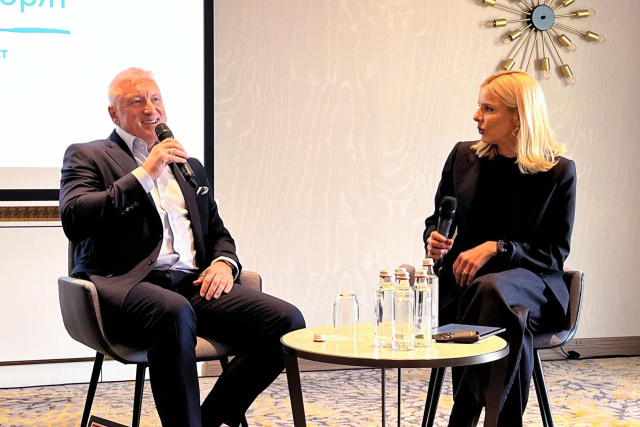
Kaufland Bulgaria has no intention of leaving the country despite a record €75 million fine imposed by the Commission for Protection of Competition (CPC), with the company’s executive director Mihail Petrov warning that the chain’s collapse would have consequences far greater than the bankruptcy of Corporate Commercial Bank (KTB).
“Stop, because Kaufland is massive. And if Kaufland goes under, the KTB bankruptcy will seem like a spring breeze by comparison. Kaufland has significant outstanding loans, a vast network of suppliers, and 8,800 employees,” Petrov said during the fourth edition of the “More than Trade” forum, organized by the Association of Modern Retailers (AMR).
His comments came in response to the penalty imposed by the competition regulator. Petrov made clear that the company intended to remain in Bulgaria, where it has already invested more than €1 billion.
“I can’t wait to get to court and tear the CPC’s act to shreds,” he said.
Addressing those calling for retail chains to leave Bulgaria, which he described as a populist position, Petrov said: “I know who you are.” He added: “You and your family also come here to shop, using this very leaflet.”
The executive director apologized to Kaufland employees for the uncertainty they were facing and the pressure caused by repeated inspections by state authorities. He noted that inspectors had been checking the store’s scales that very day.
Petrov said the scale and intensity of the inspections would otherwise have been an expensive service for the company to obtain privately. “If it weren’t so sad, we ought to thank all these state authorities – just imagine how much money Kaufland would have had to pay private auditing firms for such professional inspections,” he remarked.
He also said that representatives of inspection agencies had privately told cashiers that they risked losing their jobs if they returned to their offices without issuing fines.
“We’re just buzzing along, trying to figure out how to make money and pay our taxes – while the authorities sit there with a flyswatter, ready to swat you dead at any moment,” Petrov said.
He questioned why government institutions had chosen to target companies responsible for supplying food, arguing that retail chains were essential to the country’s food security.
“Before us, no one knew what an ‘invoice’ was. Back then, there were queues for yogurt, empty shelves, and if you wanted a block of cheese, you had to have the right connections to get it from the saleswoman. Why us? Well, that’s something others will have to explain,” Petrov said.
Turning to attacks on climate control systems and refrigeration units in Europe, he described them as a real threat, while noting that countries in the region tend to consider such risks only after an incident has occurred.
Petrov said modern warfare no longer relies primarily on atomic bombs or other conventional weapons, but increasingly takes the form of hybrid conflict, making the protection of national systems the most important priority.
He added that Schwarz Group had stepped up investments in cybersecurity, artificial intelligence and sovereign communication. The group also owns Wire, which Petrov described as one of the most secure communication channels and said was included in NATO protocols.