
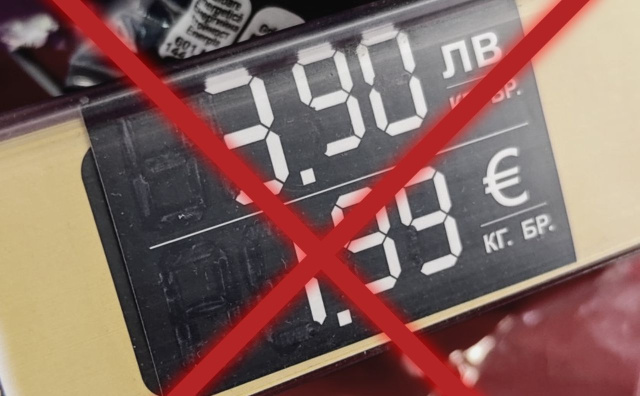
Bulgaria’s mandatory period for displaying prices in both leva and euro will end on August 8, 2026, marking another step in the country’s transition to the single European currency.
The dual price display requirement was introduced as a temporary measure to help consumers adjust to the euro and to prevent unfair price increases during the currency changeover. From August 9, merchants will be required to show the selling and payable prices of goods and services only in euro.
Businesses will still be allowed to display the equivalent value in leva voluntarily, but only as a reference. In such cases, it must be clearly indicated that the euro amount is the official price that consumers must pay, while the lev value is only informational. Both amounts must remain accurate and presented in a way that does not mislead customers.
When comparing prices, consumers should remember that the official conversion rate remains fixed at 1 euro = 1.95583 leva. Converted amounts must be rounded according to the rules set out in the Euro Adoption Act, including rounding to the second decimal place and the requirement that consumers must not be disadvantaged.
The end of mandatory dual pricing does not require businesses to immediately replace all printed materials such as menus, price lists, catalogs and brochures. These materials can continue to be used if the euro price is clearly the current payable amount and the lev equivalent is only shown for reference.
Consumer protection measures will remain in place after August 8. Authorities will continue monitoring unfair commercial practices, incorrect currency conversions and unjustified price increases.
Reports about unjustified price hikes or violations involving receipts, invoices and other payment documents will be handled by the relevant institutions. The National Revenue Agency will continue inspections related mainly to hidden income and tax violations, while complaints about unfair prices will be directed to the Consumer Protection Commission. Banks’ violations related to currency exchange, fees or customer service will continue to fall under the supervision of the Bulgarian National Bank.
Since the introduction of the euro, authorities have issued 1,550 fines and around 700 penalty orders under the Euro Adoption Act, with a total value of about 1.8 million euro, according to official data.
The end of mandatory dual pricing does not affect citizens’ rights to exchange their remaining leva. Commercial banks will continue exchanging leva into euro until December 31, 2026, although after June 30 some banks have introduced fees following the end of the initial free exchange period.
The Bulgarian National Bank will continue exchanging leva into euro free of charge, without limits on the amount and without a deadline.
For cash exchanges above 30,000 leva, citizens must submit a prior request to ensure the necessary availability of funds. Bulgarian Posts will also continue offering exchange services for smaller amounts, with fees ranging from 6 to 10 euro depending on the amount exchanged.
The new rules will gradually change how prices appear in stores, online shops and service platforms. Some major retailers have already announced their transition to euro-only price displays. METRO Bulgaria will switch on August 9, while Billa Bulgaria will remove lev prices from its stores starting August 10.
The change will apply across stores, digital platforms and promotional materials. Billa said electronic shelf labels will allow the transition to happen quickly across its network, while its promotional brochures and other communication channels will gradually move to euro-only prices. METRO said the change only affects the way prices are displayed and does not change the value of products.
Additional price transparency rules will also remain for large retail chains with annual turnover above 25 million euro. They will continue publishing daily prices of certain essential goods through a platform managed by the Consumer Protection Commission.