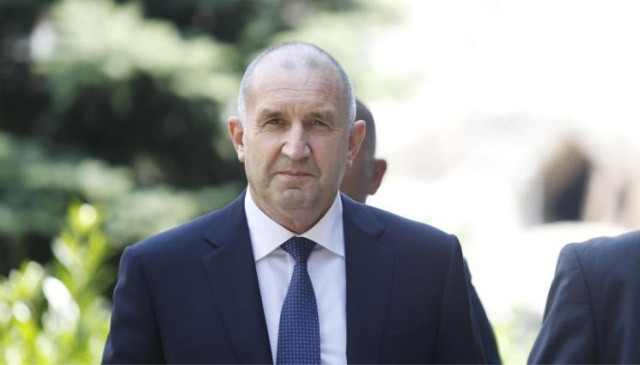
Bulgaria’s Prime Minister Rumen Radev has drawn political attention after comparing the roles of the Bulgarian Patriarch and Russia’s Patriarch Kirill, in remarks that sparked a broader debate about religion, sanctions, and foreign policy.
The comments were made following earlier statements from Radev, who eight years ago described Kirill’s visit to Bulgaria as a moment when he “arrived as a clergyman and left as a politician.” When asked why he now opposed sanctions on the Russian Patriarch, Radev insisted that his position had not changed.
“Nothing has changed, if you have listened carefully to my statements. I am not interested in the personality of Patriarch Kirill. I am interested in all Orthodox Christians and respect for their religion,” he said.
He further argued that his approach is consistent when discussing religious figures, pointing to the Bulgarian Patriarch’s own public appearances. “Here, on this square, our patriarch performs a service and blesses the Bulgarian flags and the Bulgarian army,” Radev added.
The Bulgarian Patriarch Daniil, who met with the Prime Minister, also supported the position against sanctions. He avoided direct criticism of the proposal to sanction Kirill, but said the idea was not appropriate.
“This is definitely a bold move and we do not think that sanctions against the head of a local Orthodox church achieve the interest and effect that those imposing the sanctions think. I think the decision is right,” Daniil said.
The issue has already reached Brussels, where Radev reportedly argued that Russian Patriarch Kirill should not be included in EU sanctions lists. He warned that targeting a spiritual leader could deepen divisions and complicate peace efforts, also stressing that the Bulgarian Orthodox Church should be consulted on such matters.
“The Bulgarian Orthodox Church should also have an opinion when we talk about this type of sanctions. How exactly will this contribute to the end of the war?” he said at the time, adding that Bulgaria would insist on removing Kirill from any such list.
The position triggered strong reactions across Bulgaria’s political spectrum. GERB leader Boyko Borissov accused Radev of distracting from key EU decisions, while former Foreign Minister Daniel Mitov argued that the issue was being misused politically and had little to do with religion.
Other officials warned that Bulgaria risked isolating itself within the EU. GERB’s Georg Georgiev questioned whether the country was prepared to block broader sanctions packages over the issue, while PP-DB representatives said Bulgaria should not become a “weak link” in European policy toward Russia.
At the same time, Ivaylo Mirchev of “Yes, Bulgaria” said the debate was not religious but geopolitical, calling Kirill a “political instrument of the Kremlin.” Bozhidar Bozhanov described the stance as a “strategic mistake,” warning against alignment with positions associated with Hungary.
Former Foreign Minister Ivaylo Kalfin also criticized the approach, arguing that discussions about “Orthodox families” risked distorting political realities in Europe.
President Iliana Yotova, however, expressed understanding for the government’s position, saying the topic had been “overexposed” and cautioning against turning it into a broader religious confrontation.
Beyond the sanctions debate, Radev also announced that the introduction of a “Virtues and Religion” subject in schools would return to the agenda, arguing that education should combine knowledge with moral formation.
“The issue of the subject ‘Virtues and Religion’ will be on the agenda again. It is very important that it enters schools with broad public consensus,” he said.
He also commented on wider governance issues, including budget policy, infrastructure spending, and public sector reforms, arguing that inherited fiscal problems required decisive corrective measures. Among the examples he cited were cuts to what he described as “absurd expenses,” including large infrastructure contracts and administrative inefficiencies.
According to Radev, the government is reviewing major spending areas and reallocating resources toward sectors such as agriculture, municipalities, and transport infrastructure.
The controversy over sanctions, however, remains one of the most politically sensitive topics, with Radev repeatedly insisting that his position is grounded in a separation between religious matters and geopolitical conflict.
“I do not want politics to enter religion, just as I do not want to mix religion with politics,” he said, reaffirming his stance amid ongoing criticism from both domestic and European political actors.