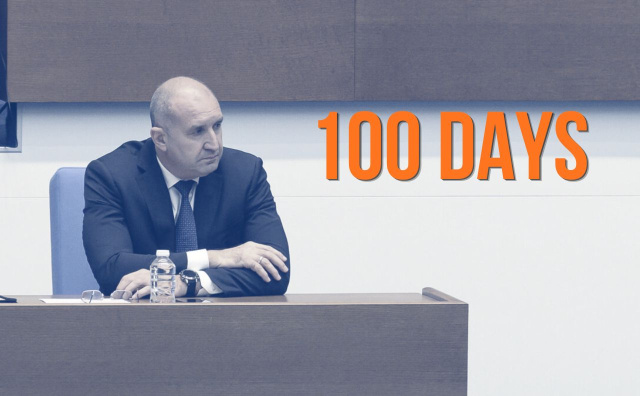
Rumen Radev‘s government will hit its hundredth day this weekend and the numbers behind it are still remarkable. Progressive Bulgaria won 131 of 240 seats in April, forming only the second single-party government since 1990. Radev became the first Bulgarian to hold both the presidency and the premiership. The cabinet was approved 124 to 70, with 36 abstentions, and took office on May 8. After five years and multiple elections that produced nothing, Bulgaria finally had a government with no coalition partners to blame and no internal opposition to manage.
That is the context in which the hundred-day marker actually means something. The concept comes from Roosevelt in 1933 and it rests on a simple premise: political capital is highest at the start and declines from day one. If reforms do not begin during the honeymoon, they usually do not begin at all. Bulgaria almost never gets to apply the standard properly, because governments here are normally coalitions fighting for survival. This one is not.
What went right
Starting with the things that worked:
The fourth Recovery and Resilience Plan payment arrived on the last day of July, €896 million, which required delivering a new anti-corruption law, changes to the Criminal Procedure Code, and the removal of loss-making coal assets from the Bulgarian Energy Holding. Mini Maritsa-Iztok and TETs Maritsa Iztok 2 are being taken out of BEH to end cross-subsidization, a condition Brussels had been pressing for years.
SIGMA, the public procurement transparency platform, is operating and pulling data from multiple registers. An analysis of public tenders found that 47% had a single bidder, which is not a statistic that leaves much ambiguity about what has been happening. Full machine voting returns for precincts with more than 300 voters and the restriction on precincts outside the EU has been lifted. The procedure for electing a new Supreme Judicial Council has been launched. A fentanyl production facility was destroyed.
The 2026 budget cut the deficit from 7.3% to around 5.6%. Sociologist Kolyo Kolev reads the whole period as a return to common sense, pointing to the absence of revanchism. There was no theatrical arrest of Boyko Borissov, no commission set up to pursue political opponents. Compared with the PP-DB approach in 2022, that restraint is visible and for a government elected on anger it was not the obvious result.
Public opinion has held up. Alpha Research put cabinet approval at 42% against 33% negative in late July, with Radev personally at 48% trust. Gallup International Balkan found almost identical numbers a week later, 42% trust and 33.6% distrust.
What did not
The promise that won the election was dismantling the oligarchic model. A hundred days in, the government has produced a 200-page program with roughly 1,000 measures and no definition of who the oligarchs are.
The first real test arrives on August 19. The legal dispute over 29% of the Plovdiv Fair shares sits with Finance Minister Galab Donev. If he does not confirm the state is continuing the case, the court can terminate it and Georgi Gergov, a long-time BSP figure in Plovdiv and the de facto master of the Fair, keeps control without the merits ever being examined. Plovdiv is not an accidental venue. Radev commanded the Graf Ignatievo airbase there, his chief of staff Nikolay Koprinkov came from the region, as did adviser Plamen Uzunov and Interior Minister Ivan Demerdzhiev.
The appointments tell their own story. State companies and the second tier of administration filled up with cadres from GERB, BSP and There Is Such a People. Radev did not dismantle the system of party appointments.
On prices, the “Care Basket” failed almost immediately after launch. The replacement, a methodology setting the “fair value” of basic foods, has been criticized by economists as a price ceiling that will push prices higher. The long-awaited food chain law has been pushed to March 2028, with the associated market construction scheduled for 2030, the final year of the mandate.
Alpha Research’s policy effectiveness index found the widest gap between public expectation and government action on exactly the issues people care about most: prices, corruption, healthcare and road safety.
Foreign policy is where the real change happened
Bulgaria did not join the Coalition of the Willing. Radev said in Paris on July 14 that Macron invited him personally and he declined, arguing the war needs a diplomatic solution. The complication came later, when Foreign Minister Velislava Petrova signed a declaration on strengthening Bulgaria‘s participation in the coalition’s work, which left the government‘s actual position unclear.
Sofia also threatened to veto EU sanctions against Russia, and at Radev‘s request Vagit Alekperov, Patriarch Kirill and Iskander Makhmudov were removed from the list. All three are sanctioned by other Western countries. On August 9, Yuri Pilipson of the Russian Foreign Ministry told TASS that Bulgarian rhetoric had become more restrained and acquired rational elements, while adding that Moscow sees no near-term prospect of restored relations given Sofia’s dependence on Brussels.
Meanwhile Turkey went from neighbor to privileged partner in three months. At least seven government-level meetings between May 22 and August 13. Radev met Erdogan in Ankara on July 6. A new protocol freezes payments under the Bulgargaz-Botas contract for 15 months, with the conditions undisclosed and the fate of more than USD360 million owed unclear. Turkish state company TPAO took 33% of exploration rights in the Khan Tervel Black Sea block. The Varna-Burgas Black Sea highway will be built by Bulgarian and Turkish companies. The 71-kilometre Yambol-Elhovo-Lesovo rail link is in the programme with a 2030 deadline, giving Turkey a second rail entrance to European markets.
There is a coherent strategic argument here. The Middle Corridor from China through Central Asia and Turkey bypasses Russia entirely and Bulgaria positioning itself on that route makes sense. The problem is that the Turkish rapprochement was at least declared openly while the Russian one was not.
The tone
Radev told the opposition that the teenagers who beat a man to death on Plovdiv’s Youth Hill were “also your creatures,” and pivoted the conversation to the removal of anti-fascist monuments. Deputy PM Ivo Hristov called the accused juvenile sadists and dismissed analysis of the state’s role as essays. Neither addressed radicalization of minors. Both used a murder as a political instrument.
Where this leaves things
The honeymoon is over and the inheritance excuse expires with it. Presidential elections come on October 25, with current President Yotova running and no announced opponent two months out. Local elections follow next year. The pattern in Bulgaria is that unpopular but necessary decisions get postponed until after every vote… and there is always another vote.
The government has stability no Bulgarian cabinet has had in years, which is precisely why the excuses will stop working. A hundred days in, the intentions are clearer. The actions are still pending.